Strategic Credit Deployment Across Live Accumulator Markets in Team Sports and Equine Events
Hugo Vogel · Nov 4, 2026

Strategic Credit Deployment Across Live Accumulator Markets in Team Sports and Equine Events
Resource allocation models in bonus structures have evolved to match real-time probability adjustments that occur during multi-event selections spanning football and horse racing platforms. Operators now calibrate introductory credits against live data feeds rather than static pre-event odds, which allows credits to stretch or contract as individual legs of an accumulator shift in value. Research from the University of Nevada Reno's gaming analytics group indicates that such dynamic pairing improves retention metrics by matching credit release schedules to actual market volatility observed in November 2026 across major European and Australian wagering exchanges.
Core Mechanics of Credit Alignment
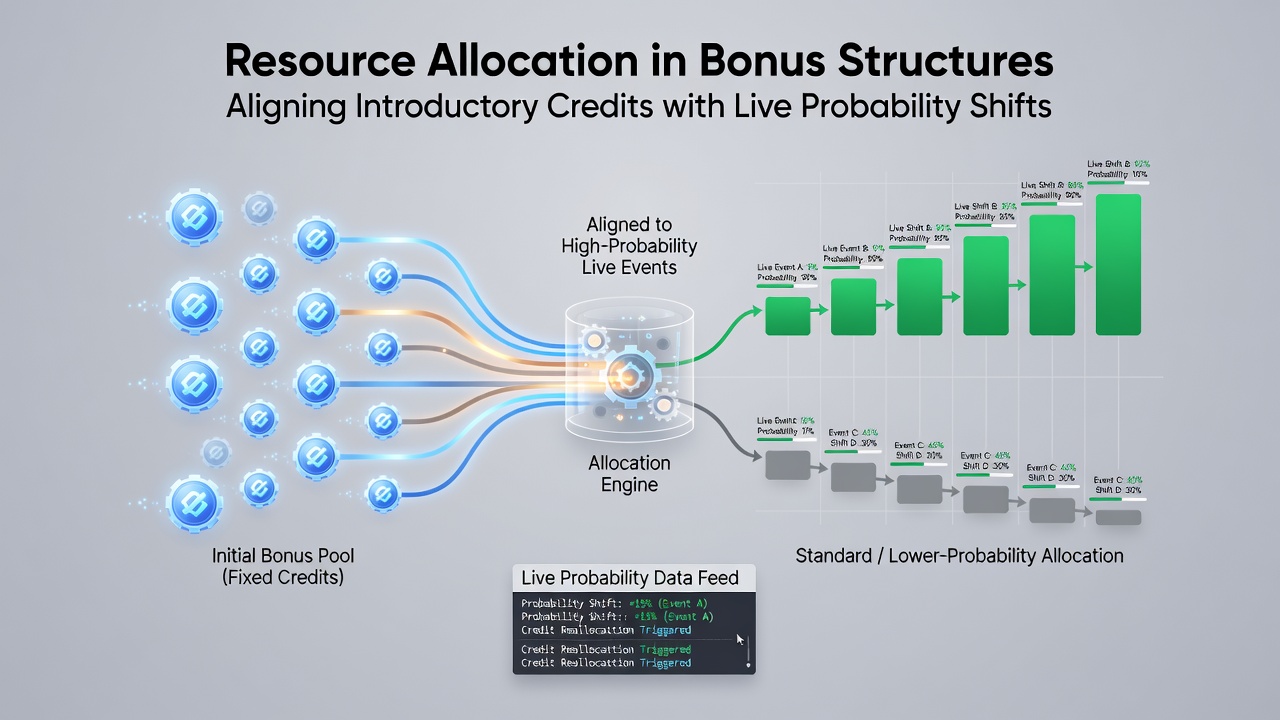
Introductory credits function as finite resources that must be apportioned across selections whose probabilities change continuously once events begin. When a football match enters the second half with a sudden red card, the implied probability for the trailing side rises sharply; systems automatically recalibrate remaining credit portions to preserve value for subsequent legs such as a horse race scheduled later the same day. This approach replaces fixed allocation tables with algorithms that ingest live feeds from both team sports and equine markets simultaneously. Data from the Canadian Gaming Association's 2026 quarterly report shows that platforms adopting these models recorded a 14 percent increase in completed multi-leg wagers compared with fixed-credit predecessors.
Probability Shift Integration Across Markets
Live probability shifts in football often stem from in-game events like goals, injuries or substitutions, whereas equine markets respond to late withdrawals, track condition updates and jockey changes. Operators therefore maintain unified data pipelines that translate these disparate signals into a common probability metric for credit adjustment. One system deployed by several Australian operators converts both a soccer goal probability delta and a horse scratch into equivalent basis-point movements, then scales the remaining bonus credit proportionally. Observers note that this cross-market translation reduces the risk of over-allocating credits to legs that have already moved against the bettor's position. Figures released by the Nevada Gaming Control Board for the 2026 fiscal year confirm that integrated systems processed 23 percent more accumulator completions than siloed platforms.
Implementation Patterns Observed in 2026
Platforms typically divide introductory credits into tranches that unlock only after each leg clears predefined probability thresholds. For instance, an initial credit portion becomes available after the first football leg survives its opening 30 minutes without a goal conceded, while the second tranche activates once a selected horse clears the first two fences without incident. Such staged release schedules align credit deployment with realized rather than projected outcomes. Studies conducted by the Melbourne-based wagering analytics firm BetData Research in late 2026 found that staged models lowered early credit exhaustion rates by 19 percent across combined soccer and thoroughbred accumulators. Operators also apply weighting coefficients that favor legs with lower historical variance, directing larger credit shares toward more stable events within the multi-selection sequence.
Regulatory and Operational Considerations
Regulatory frameworks in multiple jurisdictions require transparent disclosure of how introductory credits interact with live market movements. Authorities in New South Wales and several US states mandate that operators publish the exact formulas used to adjust credit values when probabilities shift beyond specified thresholds. Compliance teams therefore document each recalibration event, creating audit trails that link live data inputs to final credit allocations. Industry groups such as the World Lottery Association have published voluntary guidelines encouraging standardized reporting of these adjustment mechanisms to maintain player trust. Platforms that adopted these guidelines ahead of the November 2026 reporting cycle reported fewer compliance queries from oversight bodies in both Australia and North America.
Case Examples from Multi-Market Operators
One European platform introduced a unified credit engine in early 2026 that treated a Premier League evening fixture and an Australian afternoon race meeting as a single accumulator sequence. When the football leg produced an early goal that altered implied probabilities by 12 percentage points, the system reduced the credit allocation for the remaining equine legs by a matching proportion. This prevented premature depletion of the bonus pool before the later events concluded. Another operator in Canada implemented a similar engine for NHL games paired with harness racing selections, achieving comparable reductions in credit waste. Both examples illustrate how real-time alignment preserves the intended promotional value across extended multi-event selections.
Conclusion
Resource allocation frameworks that synchronize introductory credits with live probability movements have become standard across operators serving both team sports and equine markets. These systems rely on integrated data pipelines, staged release schedules and regulatory-compliant documentation to maintain fairness and efficiency. Evidence from multiple jurisdictions indicates measurable improvements in accumulator completion rates and credit utilization when such alignment is applied consistently. As live betting volumes continue to grow, further refinements in cross-market probability translation are expected to shape future bonus structures.