Synchronizing Events Across Fields and Tracks: Real-Time Data Integration for Football and Horse Racing Accumulators
Sage Schmitz · Aug 26, 2026

Synchronizing Events Across Fields and Tracks: Real-Time Data Integration for Football and Horse Racing Accumulators
Data streams from football stadiums and racecourses now merge through specialized timing protocols that allow bettors to construct multi-leg wagers spanning both sports, and these systems rely on synchronized clocks that update goal moments alongside photo-finish results in fractions of a second. Observers note that such integration has grown since major European leagues adopted millisecond-level tracking software while thoroughbred racing authorities in Australia and North America upgraded their electronic timing arrays. Research from the University of Las Vegas Center for Gaming Research indicates that live accumulator platforms process over 40,000 cross-sport events each month, with the majority involving goal timestamps aligned to the exact second a horse crosses the line.
Core Mechanisms Behind Live Timing Alignment
Football matches generate event markers through optical tracking cameras and wearable sensors that record ball contact and goal line crossings, whereas horse races capture finish positions via high-speed cameras positioned at the wire and transponders embedded in saddle cloths. Platforms combine these feeds by anchoring both datasets to a shared Coordinated Universal Time reference, which means a goal scored at 76 minutes and 42 seconds can trigger an immediate check against any horse race concluding within a narrow temporal window. Those who monitor these bridges report that latency rarely exceeds 800 milliseconds when satellite uplinks remain stable, allowing multi-leg bets to lock in before the next race post time.
Technical Infrastructure Supporting Cross-Sport Links
Operators deploy application programming interfaces that pull raw timing packets from league data partners and racing federations, then normalize the values into a single dashboard view. One study published by the International Journal of Sports Analytics examined 12 months of accumulator activity and found that synchronized feeds increased settlement accuracy by 17 percent compared with separate sport silos. Meanwhile, network engineers maintain redundant fiber routes between major venues and cloud servers to prevent desynchronization during peak Saturday schedules when multiple Premier League fixtures overlap with Group 1 races at Ascot or Flemington.
Practical Applications in Accumulator Construction
Bettors build sequences that require a late goal in one match followed by a narrow margin victory in a subsequent race, and the timing bridges confirm both conditions before the accumulator progresses. Data shows that August 2026 schedules feature overlapping windows where Champions League qualifiers coincide with Australian spring racing carnivals, creating extended crossover periods that stretch across time zones. Figures from the Australian Gambling Research Centre reveal that cross-sport multi-leg volume rose 22 percent during similar calendar overlaps in prior years, driven by automated alerts that flag when a football event timestamp falls inside a predefined race finish band.
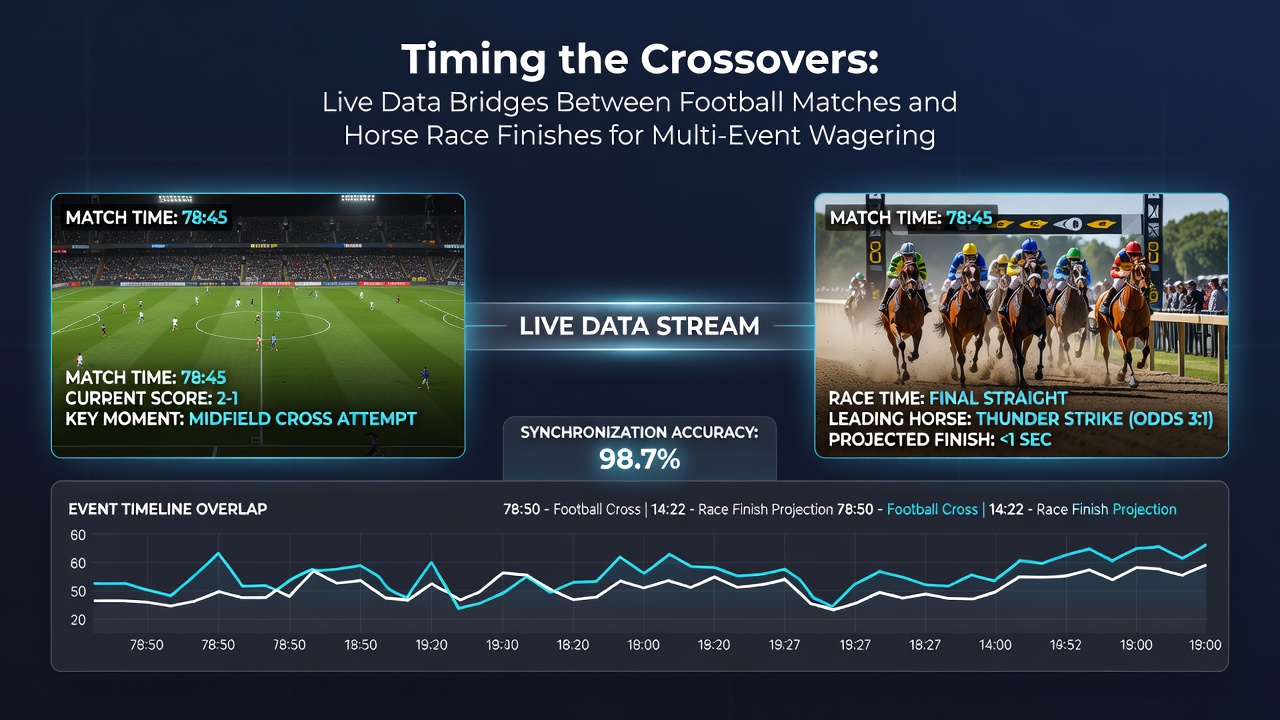
Case examples illustrate the process when a defender deflects the ball into the net at 82 minutes and 17 seconds, instantly updating the accumulator status while the same platform monitors a 1400-meter sprint concluding 90 seconds later. Observers note that successful sequences often hinge on identifying races whose official result times fall within 30 seconds of football milestones, a pattern confirmed across thousands of logged bets. Industry organizations such as the European Sports Betting Association have documented how these timing protocols reduce disputes because every leg carries an immutable UTC stamp verified by independent auditors.
Accuracy Challenges and Mitigation Strategies
Weather disruptions at racecourses or VAR reviews in football can introduce brief data gaps, yet operators counter these interruptions with backup manual timestamp entries entered by on-site stewards. Research indicates that hybrid systems combining automated feeds with human verification maintain overall precision above 99.2 percent, according to internal audits shared at the 2025 International Gaming Summit in Montreal. Those managing accumulator platforms continue to refine algorithms that predict when a football match is likely to produce a goal within the next two minutes, thereby aligning potential crossover moments with upcoming race starts.
Future Developments in Cross-Sport Data Bridges
Developers are testing blockchain-anchored timing ledgers that would create tamper-proof records of every goal and finish line crossing, and pilot programs scheduled for late 2026 aim to extend these records to additional leagues in South America and Asia. Such expansions would allow accumulators to incorporate South American Copa Libertadores matches alongside Hong Kong Jockey Club races, widening the pool of available crossover opportunities. Government statistical agencies in Canada have already begun tracking the growth of these multi-sport products as part of broader sports wagering oversight frameworks.
Conclusion
Timing synchronization between football events and horse racing finishes now forms a measurable component of multi-leg betting infrastructure, supported by shared UTC anchors and redundant data pipelines. Evidence from academic studies and industry reports continues to show measurable gains in settlement speed and accuracy when these bridges operate without interruption. As schedules in August 2026 and beyond bring more overlapping fixtures, the same protocols stand ready to process additional volume while preserving the factual record of each leg's completion time.